The GATE 2026 exam for Aerospace Engineering is a national level entrance test. It is conducted by the IITs along with IISc. This exam is very important for aerospace students. Through GATE, you can get admission to MTech and PhD programs. It also opens doors to PSU jobs. Many top public sector companies consider GATE scores for hiring. The exam is held in computer based mode. The total duration is three hours. The paper includes 65 questions in total.
The syllabus is divided into three parts. General Aptitude comes first. Engineering Mathematics is the second section. Core Aerospace Engineering subjects form the main part. The total marks for the exam are 100. Good preparation can help you score well. With the right strategy, this exam can shape a strong career in aerospace engineering.
GATE Aerospace Engineering Syllabus 2026
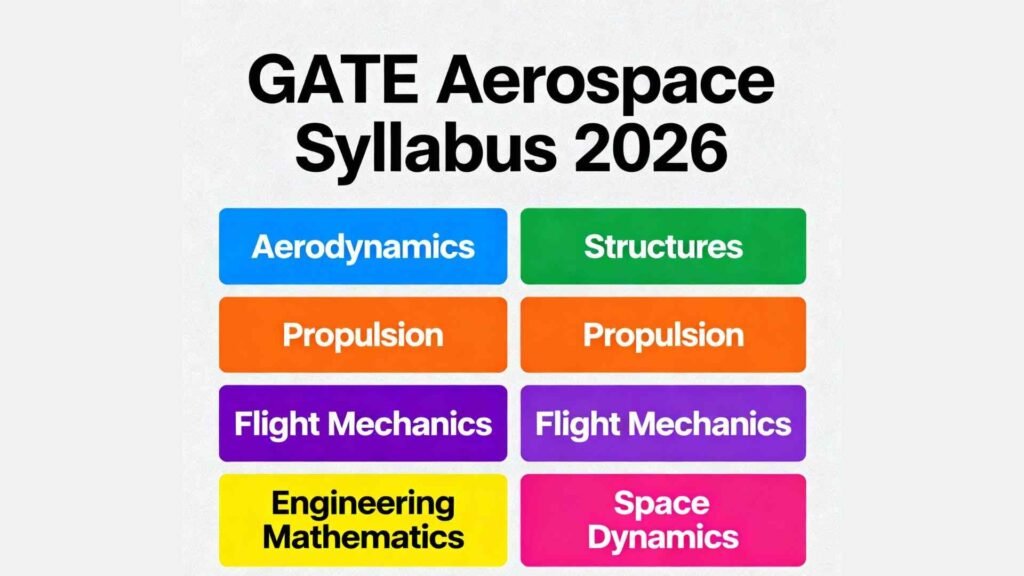
IIT Guwahati has officially updated the GATE Aerospace Engineering syllabus. It has a total of 6 major sections:
| Section | Topics |
| Engineering Mathematics | Calculus, Linear Algebra, Differential Equations, Probability |
| Aerodynamics | Fluid Mechanics, Compressible Flow, Boundary Layers, Wind Tunnel Testing |
| Flight Mechanics | Stability, Control, Maneuvering, Performance Analysis |
| Space Dynamics | Orbit Mechanics, Satellite Trajectory, Rockets & Launch Vehicles |
| Structures | Stress & Strain, Bending, Torsion, Vibration, Material Science |
| Propulsion | Thermodynamics, Jet & Rocket Engines, Gas Turbines |
Note: Download the latest PDF from the IIT Guwahati official website for the detailed syllabus. The GATE Aerospace syllabus is distinct from the degree syllabus read the official syllabus thoroughly for targeted preparation.
GATE Aerospace Engineering Exam Pattern 2026
| Section | Number of Questions | Mark Weightage |
| General Aptitude (GA) | 10 | 15 |
| Engineering Mathematics | ~9 | 13 |
| Core AE Subjects | ~46 | 72 |
| Total | 65 | 100 |
- Question types: MCQ, MSQ, NAT.
- Negative marking MCQs: -1/3 for 1 mark, -2/3 for 2 marks
- No negative marking for NAT or MSQ
GATE 2026 Exam Pattern
GATE Aerospace is an online exam with the following pattern:-
- Duration:- 3 hours
- Questions:- 65 (MCQ + NAT)
- Marks:- 100
- Question Types:-
- MCQs (with negative marking)
- Numerical Answer Type (no negative marking)
- Two Paper Option:- Mechanical + AE for dual subjects
Include mock tests and PYQs to understand question patterns and time management for each section.
Strategic Preparation Plan
Step 1: Syllabus & Topic Prioritization
- Focus on high weightage topics like Aerodynamics, Flight Mechanics, Structures and Propulsion.
- Use the official syllabus for reference.
Step 2: Study Material & Books
- Standard Books: John Anderson’s Fundamentals of Aerodynamics, Timoshenko’s Aircraft Structures and online notes from NPTEL.
- Free PDFs & Notes: Scribd, GatePathshala, AeroAdda.
- PYQ Practice: Past 10 year questions for understanding question trend and difficulty.
Step 3: Daily & Weekly Routine
- Cover Theory + Numerical Practice.
- Short notes for formulas & concepts.
- Solve topic wise quizzes and mock tests regularly.
Step 4: Practice & Revision
- Solve full length mock tests.
- Analyze mistakes and identify weak areas.
- Keep revising formulas, key concepts and important topics.
Top Strategies to Crack GATE Aerospace 2026
- Previous Year Questions: Regularly practice PYQs for understanding exam patterns and important questions.
- Time Management: Allot more time to high weightage topics.
- Online Resources & Free Study Material: Use NPTEL, YouTube, Telegram groups.
- Revision & Shortcut Techniques: Make quick revision notes, practice shortcut methods for numerical problems.
- Mock Test Analysis: Regularly examine performance and improve accuracy.
Best Books & Resources for GATE AE
| Book/Resource | Why Use It |
| Fundamentals of Aerodynamics (John Anderson) | Core concepts |
| Aircraft Structures (Timoshenko) | Structural analysis |
| NPTEL Courses | Video lectures from IIT Prof. |
| PYQ PDFs | Practice past questions |
| Online Test Series | Time management & assessment |

Free Study Material & Online Test Series
- NPTEL: Free video lectures on core topics.
- AeroAdda & GatePathshala: PDFs, notes, test series.
- YouTube Channels: GATE Aerospace preparation tips.
- Telegram Groups: Doubt clearing and sharing resources.
- Official GATE Portal: Latest notifications, syllabus, pattern updates.
Two Paper Combination
From GATE 2026 onwards students will have the flexibility to take two papers such as Mechanical + Aerospace. Regarding this decision:-
- Advantages: Overlap in subjects, flexibility in career options.
- How to Choose: Decide based on your strengths, interests and future goals.
- Preparation Tip: Cover common topics first then increase your focus on the specific paper.
GATE Aerospace Engineering Important Topics
Some sections carry high weightage every year:-
- Flight Mechanics Module (Performance, Control)
- Aerodynamics (Airfoil/Wings, Flows)
- Structures (Materials, Vibrations)
- Propulsion (Jet, Rocket)
- Engineering Mathematics
GATE Aerospace Engineering Study Material & Books
Best books and study material include:
- Fundamentals of Aerodynamics:- John D. Anderson
- Strength of Materials:- Gere & Timoshenko
- Introduction to Flight:- John D. Anderson
- Gas Turbines & Propulsive Systems:- Cohen & Rogers
- Classes/notes by reputed institutes: Made Easy, GATE Pathshala, IGC, Goodwill, Ace Academy, NPTEL.
- Free resources: Oswaal Books, Selfstudys.com, NPTEL, GATE Wallah (YouTube), Open PYQ PDFs.
Pro Tip: First gain conceptual clarity from standard books then practice previous year’s questions from free resources.
How to Start GATE Exam Preparation for Aerospace Engineering
- Download the Official Syllabus: Get the syllabus from the official website and keep a printed copy for regular reference.
- Choose the Right Study Material: Use recommended books and reliable online resources. Avoid random or unverified notes.
- Create a Structured Study Plan: Divide your time wisely for each subject and include regular revision slots in your schedule.
- Solve Previous Year Questions (PYQs): Practice GATE Aerospace PYQs from the last 10 years to understand the exam pattern and improve time management.
- Take Mock Tests and Analyze Performance: Attempt mock tests regularly, identify weak areas, and work on improving speed and accuracy.
- Make Short Notes and Formula Sheets: These help a lot during quick revision before the exam.
- Revise Smartly: Focus on consistent revision and self-testing to retain concepts better.
GATE Aerospace Two Paper Combination Subjects
IITs now offer the option of taking two papers. Popular combinations:
- Aerospace + Mechanical Engineering
- Aerospace + Engineering Sciences (XE)
- Aerospace + Physics
You can choose according to your comfort and future goals.
GATE Aerospace Engineering Preparation Strategy
- Early Start: The syllabus is quite vast. Start preparing early.
- Subject wise focus: Spend more time on high weightage topics.
- Daily Practice: Solve numerical problems for each topic.
- Online classes & doubt sessions: Use quality coaching and YouTube channels for clarity.
- Timetable: Create a realistic study plan with weekly targets and rest days.
GATE Aerospace Engineering Free Study Material
- NPTEL lectures (gate.nptel.ac.in )
- GATE Wallah YouTube channel (free playlists)
- Oswaal and Selfstudys.com (free PDFs)
Detailed Subject Wise Guide
Engineering Mathematics
Engineering Mathematics is an important part of GATE 2026 Aerospace. It includes topics like Linear Algebra, Calculus, Fourier Series, Differential Equations, and Numerical Methods. This section carries around 13 marks in the exam. Most questions are application based. So understanding concepts is more important than rote learning. Learn the formulas well. Also know where and how to apply them.
Practice previous year questions regularly. This section is considered high scoring if prepared properly. Solving PYQs will improve both speed and accuracy. For book reference, B.S. Grewal is a good choice. It helps in building strong basics. With regular practice, Mathematics can become your scoring area in GATE Aerospace.
Aerodynamics
Aerodynamics is one of the most important sections in the GATE Aerospace Engineering exam. It carries a good weight and needs strong understanding. Most questions test your concepts, not just formulas. This section includes fluid dynamics, incompressible and compressible flow, airfoils, and boundary layers. Each topic builds the base for advanced problems. So clear concepts are very important here. A large number of questions come from airfoil theory and wing mechanics. You should give extra time to these areas. Try to understand how lift is generated and how flow behaves.
Practice drawing diagrams while studying. It helps in understanding concepts better. Numerical problems should also be solved regularly. This improves both speed and accuracy. Anderson’s Fundamentals of Aerodynamics is a good reference book. It explains concepts in a simple and practical way. Do not skip important topics like Navier Stokes equations. Kelvin’s theorem is also frequently asked. Revise these topics again and again. Focus on both theory and numericals. Balanced preparation will help you score well in this section.
Flight Mechanics
The Flight Mechanics syllabus mainly includes aircraft performance, static and dynamic stability, control systems, and basic flight principles. Most questions are asked from performance charts and stability-related problems. This section can be highly scoring if you are comfortable with diagrams and quick numerical calculations. The best way to prepare is by visualizing concepts using real-life aircraft examples. For in-depth understanding, refer to Introduction to Flight by Anderson and regularly practice previous years’ questions.
Structures
The Aerospace Structures syllabus covers topics like stress–strain behavior, bending, vibrations, and aircraft structural components. Special attention should be given to Theory of Structures and Vibration of Beams, as numerical questions are frequently asked from these areas. For building strong fundamentals, Strength of Materials by Gere is highly recommended.
To score well, practice time-saving methods for beam bending, torsion, and natural frequency calculations. Solving case-based problems with diagrams will also help in better understanding and long-term retention.
Propulsion
The Propulsion section covers the basics of thermodynamics, jet propulsion, rocket propulsion, and turbomachinery. Gas Turbine Theory by Cohen is a very useful book for understanding these concepts. Most questions are based on jet and rocket cycle diagrams, efficiency calculations, and thrust-related formulas.
To score well, focus on learning simplified calculation methods, as word problems can take more time during the exam. Both numerical accuracy and conceptual understanding are equally important in this subject.
Space Dynamics
Space Dynamics covers orbital mechanics, launch vehicle trajectories, escape velocity, and circular velocity. The section includes both conceptual and analytical questions. A clear understanding of the basics is essential. Practice standard formulas for orbital velocity, Hohmann transfer, and energy calculations. Focus on solving numerical problems and derivation-based questions. For effective preparation, online resources and NPTEL lectures are highly recommended.
Study Plan for GATE Aerospace Preparation
| Month | Tasks |
| 1-2 | Syllabus reading + basic concepts, select best study material |
| 3-4 | Subject-wise theory coverage + daily MCQs, weekly revision |
| 5-6 | Intensive PYQ practice, topic-wise tests, formula notes |
| 7 | Full-length mocks, error analysis, weak topic revision |
| Last month | Rapid revision, daily formula review, rest days for balance |
Mistakes to Avoid in GATE Aerospace Engineering
- Ignoring Engineering Mathematics and General Aptitude: Both carry significant weight.
- Relying on random notes: Always use standard study material and books.
- Skipping Mock Tests: Practicing mock tests boosts real exam performance.
- Unrealistic Timetable: Create a flexible study plan, don’t overburden yourself.
- Not Analyzing Mistakes: After attempting mock tests or previous year questions, understand the solutions and note down your errors.
Latest Trends & Exam Analysis
- The 2025 AE paper was easy to moderate with the Flight Mechanics & Aerodynamics module having the highest weightage.
- The number of numerical and concept-based MCQs is increasing each year.
- Practice solving NAT and MSQ questions along with MCQs.
How to Utilize GATE AE Previous Year Questions
Practice using previous year questions (PYQs) enhances insight into the pattern and level of difficulty.
Solved PYQs under test conditions emphasize subjects such as Aerodynamics and Flight Mechanics.
Do not miss comparing the solutions; mark your weak areas.
GATE 2026 Aerospace Engineering Examination Dates and Eligibility
Exam Dates: February 7, 8, 14, 15, 2026 (refer to the branch-wise schedule on the official website)
Eligibility: 3rd year or final year Bachelor’s degree in Engineering/Technology/Science (2nd year diploma holders are not eligible)
Also Read:
FAQs:
1. How to download the GATE Aerospace Engineering syllabus?
Go to the official website (gate2026.iitg.ac.in ) click on your paper and download the PDF.
2. What are the best books for GATE Aerospace Engineering?
Anderson’s Aerodynamics, Gere’s Strength of Materials, Cohen’s Propulsion, PYQ books.
3. Can B.Tech 2nd year students appear for GATE Aerospace?
No. Only final year or 3rd year Bachelor’s degree holders are eligible.
4. What is a two-paper option for GATE Aerospace?
You can opt for AE with Mechanical, Engineering Sciences or Physics, based on your strong areas.
5. What is the cut-off for GATE Aerospace?
Cut-off varies annually (generally 25-35 marks for general category); refer to official notifications of the current year.
6. What is the weightage of General Aptitude in GATE AE?
15 marks; it is typical for all branches.
7. How to take GATE AE mock tests?
Subscribe to online/coaching test series or free test websites like Testbook, Made Easy or live tests on YouTube.
8. How to prepare for GATE AE for free?
NPTEL video lectures, free notes/resources (Selfstudys, Oswaal, GATE Wallah)
9. What are the key topics in GATE AE?
Flight Mechanics, Aerodynamics, Structures, Propulsion, Engineering Mathematics.
10. What is the function of IIT Guwahati in GATE 2026?
Organizing institute for GATE 2026; all notifications are on the official website.
11. Is GATE Aerospace Engineering difficult?
Moderate; can be cracked with regular, systematic preparation.
12. What is the GATE Aerospace syllabus 2026?
There are 6 prominent sections: Math, Aerodynamics, Flight Mechanics, Structures, Propulsion, Space Dynamics.
13. What are the best books for GATE Aerospace?
John Anderson, Timoshenko, NPTEL notes, PYQ collections.
14. What is the pattern of GATE exam?
65 questions, 3 hours, MCQs + NATs, 100 marks.
15. How can I study for free?
NPTEL, AeroAdda, Telegram groups, YouTube.
16. What are the marks of the GATE Aerospace exam?
100 marks, 65 questions.
Practical Tips:
Practice and revise every day without fail.
Finish the syllabus in advance, then revise.
Test your speed and accuracy through mock tests.
Target high-yield topics for maximum marks.
Conclusion
You are now fully prepared to start your GATE 2026 Aerospace Engineering journey. Begin with the complete syllabus and the right study material. Practice daily, solve previous year questions, make short notes, and revise them regularly. Stay updated with official notifications and keep an eye on exam trends. With consistent effort, the right strategy, and smart preparation, success will surely follow.
Disclaimer: This content does not contain any promotions. It simply mentions coaching and books that had good ratings and it is not necessary. If the study material you have is updated then that’s fine.